May 6, 2026
The Difference Between Community and Association — Organizing the Concepts of Shared Body and Society
The ambiguity of the word “community”
Among people who say “I want to build a community,” some have a Discord server in mind, others a user group, others a hobby connection. It’s not unusual for the same word to point at completely different things.
To organize this ambiguity, the distinction between “community” and “association” — proposed by the sociologist Robert M. MacIver in his 1917 book Community — is helpful. Though about 100 years old as a concept, it can still serve as the starting point for design decisions in today’s online initiatives.
MacIver’s definition — Shared body and society
MacIver split the forms in which people gather into two.
A community is a “shared body” that arises naturally by sharing a region, an interest, or attributes. Participants find meaning not in serving a particular purpose but in “being there” itself. Villages, families, neighborhood groups, and circles gathering around a theme are examples.
An association is a “society” deliberately created to achieve a particular purpose. Participants are bound by sharing the purpose, and disbandment is conceivable when the purpose is achieved or disappears. Companies, schools, labor unions, and NPOs are examples.
| Quality | Community (shared body) | Association (society) |
|---|---|---|
| How it arises | Spontaneously | Deliberately founded |
| Axis of bond | Sense of belonging / shared context | Common purpose / interest |
| Participation motive | ”I want to be here" | "I want to achieve something” |
| Relation to purpose | Place precedes purpose | Purpose creates the place |
| Concept of disbandment | Thin (continues even as members change) | Present (disbands when purpose disappears) |
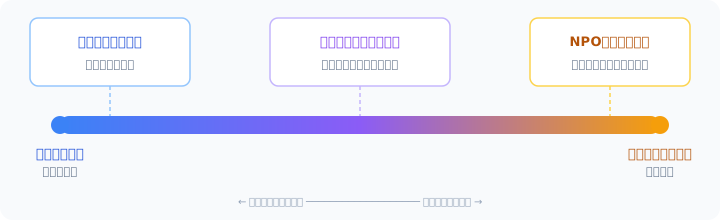
Blurring of the boundary in modern times
In MacIver’s era, communities were strongly tied to locality (villages, towns). The geographical shared body was the premise. But with the spread of the internet and especially social media, “people who don’t share a place gathering by interest alone” became possible.
This change blurs the boundary between community and association.
- An online hobby group is a community-like place that holds together without a purpose, yet it has association-like structure in its use of tools like Slack or Discord
- A user group founded by a company is an association with explicit KPIs, but as participants’ sense of belonging grows, it takes on community-like qualities
What matters is not the mindset of “must classify into one or the other,” but recognizing “which quality is currently stronger in our place.”
Comparison in corporate initiatives — Participation motive, KPIs, operational cost
When a company designs a community initiative, the difference between community and association qualities directly affects practical decisions.
| View | Community-leaning | Association-leaning |
|---|---|---|
| Participation motive | Belonging / empathy / self-expression | Learning / information gathering / networking |
| KPI | Retention rate / temperature / qualitative evaluation | Goal achievement rate / participation count / cost efficiency |
| Operational stance | Maintaining the place / preserving context | Driving the purpose / executing the program |
| Member relationships | Lateral connections are central | Vertical purpose axis is central |
| Operational cost | Higher (long-term relationship building required) | Clear (controllable per program unit) |
There is no correct answer — the direction to lean depends on what your initiative is trying to achieve.
If you want to nurture customer loyalty or a sense of belonging, a community-leaning design is suited. If specific skill acquisition, information sharing, or enlightenment is the goal, an association-leaning approach more often produces results.
Connecting to theme-based and corporate types
This concept overlaps with the two launch archetypes for communities.
The theme-based community explained in Things to decide before starting a community that is not “purpose-first” gathers around interest, motive, and belonging — meaning it has community-leaning (shared body) qualities.
On the other hand, the corporate community explained in Three things to decide before launching a corporate community — premised on connection to business KPIs — tends toward association-leaning (society) qualities.
That said, this is not fixed. Even an association-like place started by a company will, as participant-to-participant dialogue grows and a sense of belonging develops, accumulate community-like qualities. Conversely, theme-based communities that include purposeful activities — running specific events or publishing projects — develop association-like aspects.
The five types shown in Types of communities and how to choose can also be understood more dimensionally when revisited along the community ↔ association axis. Customer and learning communities have stronger association-like elements, while local/theme communities tend toward stronger community-like elements.
”Quality of connection” seen from Social Capital
A perspective that deepens MacIver’s concept further is research on Social Capital.
The political scientist Robert Putnam defined Social Capital as “features of social organization, such as trust, norms, and networks, that can improve the efficiency of society by facilitating coordinated actions.” A large-scale survey conducted by the Cabinet Office (2002) brought this into the Japanese context and measured it via three elements: association/exchange (networks), trust, and social participation (norms of reciprocity).
Bonding SC and bridging SC
Putnam further classified Social Capital into two kinds. This corresponds deeply to the distinction between community and association.
| Bonding SC | Bridging SC | |
|---|---|---|
| Corresponding quality | Community-leaning (shared body) | Association-like function |
| Connection traits | Strong internal bonds among homogeneous members | Loose net spanning heterogeneous people / organizations |
| What it produces | Strong trust / solidarity / belonging | Information flow / diversity / a lubricant for society |
| Risks | Insularity / exclusion / over-insularization | Connections feel thin and solidarity tends to be weak |
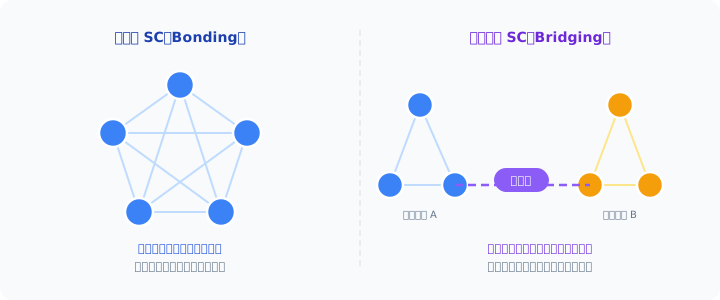
A key finding from the Cabinet Office’s survey is that “community (shared body)–like places easily produce bonding SC, but in excess this leads to insularity and exclusion.” On the other hand, association-like places like NPOs and civic activities more easily produce bridging SC connecting people of different backgrounds.
Implications for corporate communities
Applying this perspective to corporate communities reveals an important design tradeoff.
Designing too far toward the community-leaning (shared-body) end raises the sense of belonging among regulars but creates a risk of becoming an “insider place” that newcomers cannot easily enter. This is the over-extended state of bonding SC.
On the other hand, designing the place purely along an association-like purpose axis makes lateral connections among participants hard to form, and you fall into the cycle of “when the event ends, the relationships end too.”
The ideal direction the Cabinet Office’s survey suggests is to lay bonding (internal trust and solidarity) as the foundation while deliberately building bridging (external connection and diversity) into the design. Protecting the existing members’ belonging while keeping a structure that newcomers can enter — this dual concern is the core of community design that functions long-term.
Which side should your own initiative lean toward?
To judge the qualities of your own initiative, try answering these questions.
-
What is the participation motive? — If “wanting to connect with someone” or “wanting to be there” is central, a community-leaning design suits. If “wanting to get information” or “wanting to achieve a goal” is central, an association-leaning approach better meets participants’ expectations.
-
How do you define results? — If you weight qualitative “temperature,” “belonging,” and “word of mouth,” lean community. If you weight quantitative participation count, completion rate, and lead acquisition, association is easier to measure.
-
Is the place itself the purpose, or is the place a means to a purpose? — “I want to create a place where people can gather” is community-leaning. “I want to gather members for goal achievement” is association-leaning.
-
When participants disappear, what happens to the place? — If the place vanishes with the participants, it’s shared-body-like. If the structure remains and others can continue it, it’s society-like.
Summary — Design deliberately, with awareness of the qualities
The word “community” is used for places that are vastly different in reality. MacIver’s distinction between “shared body and society” remains useful today as a tool for clarifying what we are trying to build.
There is no good or bad. What matters is designing while consciously aware of which qualities your place has and which qualities you want it to have.
A community-leaning place needs design that nurtures belonging. An association-leaning place needs paths to the purpose and result measurement. Mixing the qualities unintentionally keeps participant expectations and operator perspectives misaligned, and tends to land you in a state where nothing you do generates excitement.
Organizing the concepts is a “map check” before stepping into the tactics talk. Design begins with verifying where your place sits on the map.
References
- R. M. MacIver, Community: A Sociological Study — Japanese translation: 『コミュニティ — 社会学的研究:社会生活の性質と基本法則に関する一試論』(supervised translation by 中久郎・松本通晴, Minerva Shobo) View on Amazon
- Yoji Inaba, 『ソーシャル・キャピタル入門 — 孤立から絆へ』 (Introduction to Social Capital — From Isolation to Bonds) (Chuko Shinsho) View on Amazon
- Cabinet Office, Social Affairs Bureau, 『ソーシャル・キャピタル:豊かな人間関係と市民活動の好循環を求めて』 (Social Capital: Toward a Virtuous Cycle of Rich Human Relationships and Civic Activity) (FY 2002 survey report) Read the PDF
Related articles
- Types of communities and how to choose — five patterns organized by purpose — Layering the community/association axis on the five-type framework makes type-selection decisions clearer.
- Things to decide before starting a community that is not “purpose-first” — Explains the “fundamental motives” and “discovery of a theme” that serve as the starting point for theme-based communities (community-leaning).
- Three things to decide before launching a corporate community — Organizes the three pre-launch decisions — purpose, audience, business connection — for association-leaning corporate communities.
- Why “context design” must come first in community operation — In community-leaning places especially, “context design” must come before tactics. Explains why dialogue does not emerge in places where context is not in order.
Contact · Rokuse LLC
Continue this conversation about your community.
If a moment in this article made you wonder "what about ours?", send that exact question. It does not have to be polished — we will work the entry point out together.
Frequently asked questions
- Q. Which is superior, community or association?
- A. The question of which is superior is not appropriate. Communities (shared bodies) cultivate a sense of belonging and solidarity among participants, while associations (societies) efficiently produce results under a clear purpose. The right approach is to choose which side to lean toward depending on what your initiative wants to achieve.
- Q. Can a community run by a company only ever be an association?
- A. Not necessarily. Even in a place a company set up, if a sense of belonging and autonomous connections grow among participants, the place takes on the qualities of a community (shared body). However, when KPIs and business purposes are pushed to the foreground, participants' motives tend to converge on "interest-based ties" and the place tilts toward an association.
- Q. Is the difference between theme-based and corporate communities the same as the difference between community and association?
- A. There is significant overlap, but they don't fully match. As an empirical pattern, theme-based communities tend toward community (shared body), and corporate communities tend toward association — but depending on design, the reverse is also possible. For details, see the article "Things to decide before starting a community that is not 'purpose-first'."
- Q. How do I judge which side it is?
- A. Try asking, "If the participants disappeared, would the place continue to exist?" A community (shared body) is constituted by the very existence of its participants, so if everyone leaves, the place vanishes too. An association (society) has its purpose and structure first, so it keeps functioning even as members rotate. Use this difference as a clue for classifying your own place.
- Q. What is the relationship between Social Capital and community/association?
- A. The Cabinet Office's survey (2002) captured Social Capital through three elements — "association/exchange," "trust," and "social participation." A community (shared body) easily produces "bonding" SC among homogeneous members; while solidarity is strong, it carries risks of insularity and exclusion. On the other hand, association-type civic activities and NPOs tend to produce "bridging" SC connecting heterogeneous people, functioning as a lubricant of information flow and society. In corporate communities too, designs that prevent over-insularization (excessive bonding) while embedding bridging functions lead to long-term vitality.